
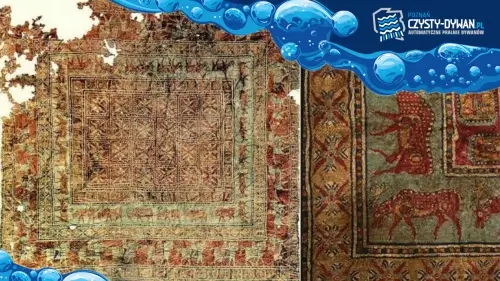
The oldest known carpet in the world, the PAZYRYK, was probably made in areas under the influence of ancient Persia in the 3rd century BC.
It is housed in the State Hermitage Museum in Saint Petersburg, Russia.
The carpet was found in 1949 during archaeological work carried out by Russian scientists under the direction of Sergei Rudenko in one of the Scythian burial mounds in the Pazyryk Valley in the Altai Mountains (Siberia) — hence its name, PAZYRYK.
The preserving factor that allowed the carpet to remain in good condition was the formation of permafrost beneath the burial mound embankments. The permafrost also partially protected the mounds from complete looting — the graves had already been robbed in antiquity. In order to extract the objects stored inside the mounds, archaeologists poured buckets of hot water over the chambers to melt the ice.
Woven from wool, the carpet is of high quality and, unlike modern carpets, was woven more densely — around 36,000 Giordes knots per 1 m², with a pile height of 2 mm.
The dimensions of the carpet are 1830 mm x 1980 mm. In the central section, there is a star-shaped motif repeated in four columns of six elements each. The star-shaped pattern is formed by two differently colored crosses placed on top of each other at a 45-degree angle. The rectangular central section is surrounded by five borders separated from one another by six narrower borders with colored blocks in the sequence black-white-red-white.
Looking from the center outward, the first border contains a medallion motif repeated 42 times, depicting a creature resembling a griffin, shown in a manner similar to an Assyrian griffin. The medallion is surrounded by series of white and black dots — a pattern known from the Achaemenid period, which later became characteristic of the Sasanian period (224–651). The second border depicts 24 animals resembling deer — most likely elk or reindeer. Some researchers have pointed to the similarity of these depictions to images from Achaemenid palaces.
The third border contains 69 star-shaped symbols similar to those in the central section, while the fourth contains 28 depictions of human figures on horseback or walking beside horses. All the horses are of similar build, shown with braided tails, bridles, and saddlecloths with individual patterns. The final, fifth border repeats the medallion motif with a griffin-like creature 94 times.
Michał Miłowski